
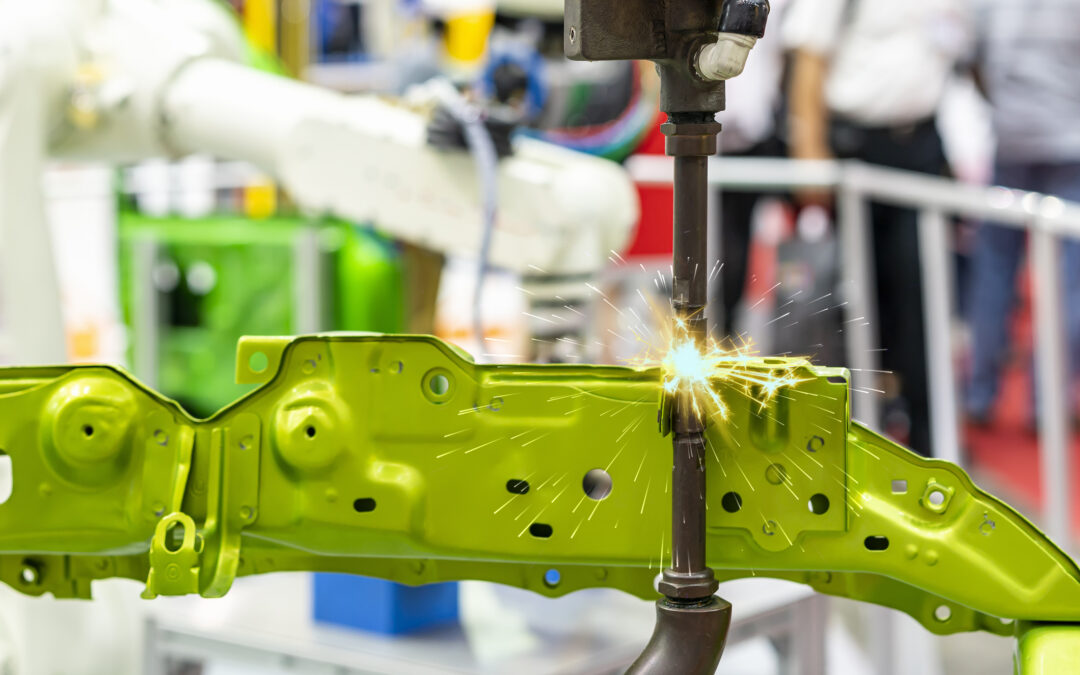
Over the past six years, the A/SP Joining Team has led a focused, data-driven effort to understand and mitigate Liquid Metal Embrittlement (LME) in resistance spot welding of 3rd Generation Advanced High-Strength Steels (3rd Gen AHSS). This work has helped remove a key barrier to broader automotive implementation.
Why LME Matters
LME requires three conditions: a zinc source, tensile stress, and a susceptible material. Early industry experience suggested that some 3rd Gen AHSS grades were more susceptible than comparable-strength steels, raising concerns during production welding.
Phase I – Gleeble-Based Simulation
A laboratory test using a Gleeble system was developed to dynamically simulate spot weld thermal-mechanical conditions across temperature and strain rate.
Key outcomes:
⚙️ Higher LME susceptibility observed in certain 3rd Gen grades
⚙️ Significant supplier-to-supplier variation identified
⚙️ Coating type was not a dominant variable
While insightful, the method was time-intensive, qualitative, and not fully representative of production welding.
Phase II – Rapid LME Test Development
To better replicate production conditions, the team developed the Rapid LME Test—a spot weld–based method using incremental weld currents followed by metallographic evaluation.
Advantages:
⚙️ Faster and lower cost
⚙️ Directly representative of spot welding
⚙️ Strong correlation with Gleeble results
Although crack evaluation remained somewhat subjective, the Rapid LME Test became a practical screening tool for material susceptibility.
Phase III – Heterogeneous Joint Evaluation
Evaluation of mixed-thickness joints revealed weld penetration challenges due to electrical resistivity differences. Process optimization improved performance, but confirmed that a single standardized weld schedule could not universally qualify heterogeneous joints.
Conclusion: The Rapid LME Test is highly effective for assessing material susceptibility, but not a universal joint qualification method.
Industry Impact
⚙️ Enabled development of LME process maps
⚙️ Supported weld modeling with LME prediction
⚙️ Guided development of LME-resistant weld schedules
⚙️ Accelerated improvements in 3rd Gen AHSS formulations
Suppliers whose early grades showed higher susceptibility demonstrated rapid material refinement in later submissions—highlighting how structured testing drives innovation.
Looking Forward
The focus has shifted from identifying LME susceptibility to actively mitigating it. Ongoing work includes weld process modeling, predictive LME mapping, and validation of robust production weld schedules.
Reducing LME risk is essential to unlocking broader adoption of 3rd Gen AHSS in support of OEM safety, performance, and sustainability objectives.
Find more helpful information about LME at A/SP Joining Team